- Flooring
What Does Waterproof Flooring Actually Mean? A Montana Homeowner’s Guide to LVP Claims
August 25, 2026
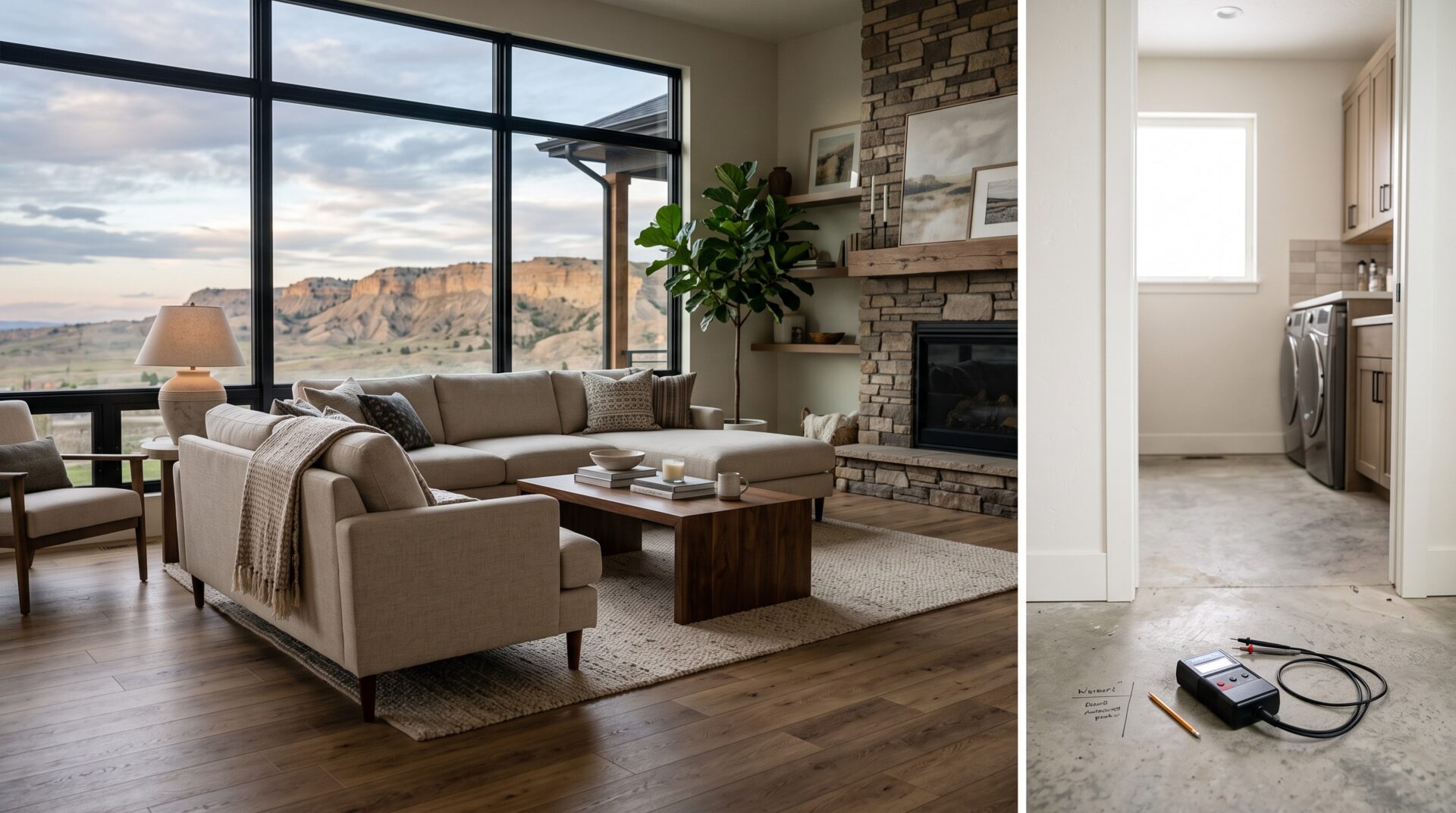
“100% Waterproof” is one of the most common phrases in flooring marketing right now, and one of the most misunderstood. Walk into any big-box store and you will see it on three-quarters of the vinyl plank displays. Read it on a product page and it sounds like the question of moisture is solved. For most above-grade applications with good drainage, it largely is. For a Billings basement or a first-floor room over clay-heavy soil, the claim deserves a much closer reading.
This guide explains what waterproof LVP actually protects against, what it does not protect against, and how the difference between standard LVP, WPC, and SPC changes the answer in a meaningful way for Montana homeowners. The bottom line up front: for a Billings below-grade space, SPC rigid-core LVP over a properly rated vapor barrier — confirmed by a slab moisture test — is the correct specification. Everything else in this article explains why.
Book a free in-home estimate with the Pierce Flooring Billings team at (406) 652-4666 before you commit to any floor for a below-grade or moisture-adjacent space — we test subfloor moisture as part of every consultation.
What ‘100% Waterproof’ Actually Means on an LVP Label
When a manufacturer calls LVP ‘100% waterproof,’ they are describing the product’s surface layer. The vinyl wear layer and the printed design layer beneath it will not absorb liquid spilled on top. A glass of water, a pet accident, a tracked-in wet boot — none of these penetrate the face of a quality LVP floor. That claim is accurate, and it is why LVP has largely replaced hardwood and laminate in kitchens, bathrooms, and laundry rooms across the country.
What the label is not describing is the product’s resistance to moisture that arrives from below. Below-grade moisture is a completely different mechanism. It does not arrive as a puddle or a spill. It arrives as water vapor, moving upward through a concrete slab under vapor pressure, drawn toward the drier indoor air above. That vapor does not care about the wear layer. It works into the seams between planks, into the click-lock joint, and into the space between the floor and the subfloor.
The Resilient Floor Covering Institute (RFCI) publishes installation standards for LVP over concrete, and those standards specify maximum moisture emission thresholds that slabs must meet before any LVP product is installed. The thresholds exist because even products marketed as 100% waterproof can fail when installed over a concrete slab that emits vapor above those limits. The waterproof label describes the top of the floor. The installation standards describe the bottom.
Pro-Tip from the Pierce Flooring Billings Team: We get calls from Billings homeowners every year who installed a 100% waterproof LVP product in their basement, followed the directions on the box, and are now dealing with edge lifting or adhesive failure 12 to 18 months later. When we visit, the story is almost always the same: the slab was never moisture tested before installation. In Billings — especially in Westend and Lockwood where homes sit on expansive clay soils — the slab moisture reading can be well above safe installation thresholds even when the basement looks and feels completely dry. The box never tells you that.
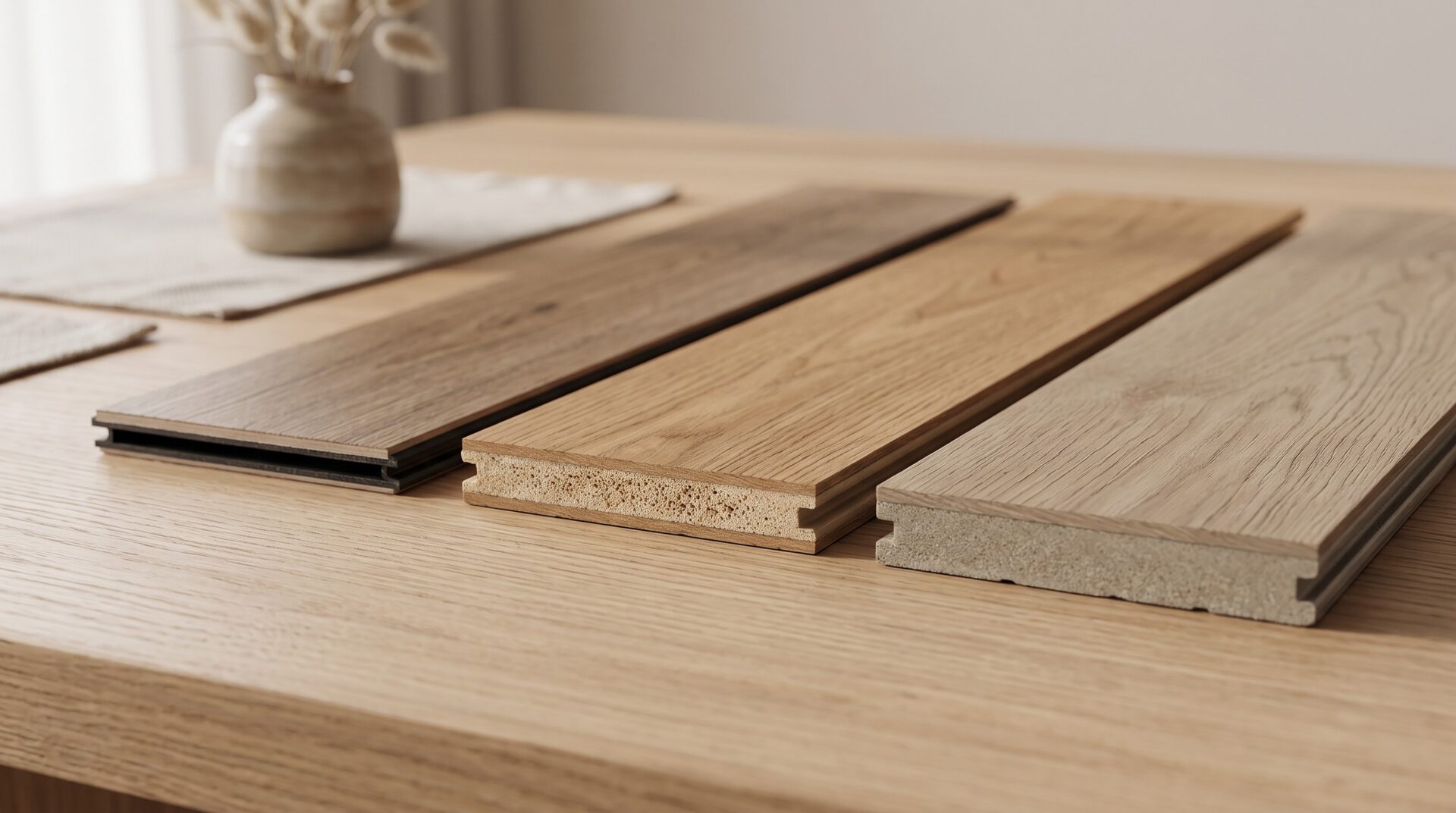
The Three Products Sold as ‘Waterproof LVP’ — and Why They Are Not the Same
Standard LVP (Flexible Core)
Standard luxury vinyl plank has a flexible vinyl composite core. The surface is genuinely waterproof. The core is not moisture-sensitive in the way wood is, but it responds to temperature changes and moisture pressure over time by expanding and contracting. In Montana’s seasonal humidity swings — from under 20% in January to 60%+ in summer — a floating flexible-core LVP floor develops small seasonal movements at the seams. Under repeated moisture pressure from below, those movements become infiltration pathways.
Standard flexible-core LVP is the right product for above-grade installations with good subfloor conditions. It is not the right product for a Billings basement, a slab-on-grade first floor over clay soil, or anywhere that below-grade vapor pressure is a realistic condition.
WPC (Wood Plastic Composite)
WPC flooring adds a wood-plastic composite (WPC) core — typically foamed in mid-tier products, solid in some higher-tier lines — beneath the vinyl layers. The foam version is softer underfoot and better at sound absorption than standard LVP. It is also thicker, improving thermal feel in cold rooms.
The tradeoff for a Montana basement is that foamed WPC cores are less dimensionally stable than rigid SPC cores under prolonged below-grade vapor pressure. WPC performs well in above-grade applications with occasional moisture exposure. For chronic below-grade vapor conditions in a Billings home, SPC is the more durable specification.
SPC (Stone Plastic Composite) — The Correct Specification for Billings Below-Grade
SPC replaces the composite core with a rigid limestone-infused polymer core. It is the densest and most dimensionally stable of the three products and holds its form across Montana’s humidity swings significantly better than standard LVP or WPC. SPC is also generally more heat-stable over radiant systems than standard LVP or WPC — though specific radiant-heat compatibility still depends on the product’s rated maximum surface temperature, so confirm the specific collection’s spec sheet before installing over a radiant system.
For a Billings basement or any slab-on-grade installation with below-grade moisture potential, SPC is the correct specification. The RFCI installation standards still apply — SPC does not eliminate the need for a moisture test and a properly rated vapor barrier — but SPC’s rigid core handles the residual vapor exposure that passes through a correctly specified barrier better than either standard LVP or WPC. For a complete walkthrough of the slab moisture testing process and vapor barrier selection, see our guide to waterproof flooring for Montana basements.
Cali and Mohawk both produce SPC collections rated for below-grade applications and carried at the Pierce Flooring Billings showroom. The starting point is always the slab moisture test — not the product selection.
What the Waterproof Claim Does Not Cover in a Billings Home
Seam Infiltration Under Sustained Moisture Exposure
The click-lock joint between LVP planks is mechanically tight but not chemically sealed. Water that sits at a seam — from a pet accident left unattended, a washing machine leak, or ongoing vapor pressure from below — works into the joint over time. The floor surface may remain intact while the seam and the subfloor below accumulate moisture that eventually causes adhesive failure, edge lifting, or mold growth in the underlayment. For how this plays out specifically in pet households, see our pet flooring guide for Montana homes.
Billings Clay-Soil Vapor Pressure
The Haverson-Yawdim-Enbar clay soils under Westend and Lockwood homes hold and release moisture seasonally. Even during Billings’ dry summers, these soils maintain subsurface moisture that creates vapor pressure upward through concrete slabs. A slab that tests within safe moisture limits in October may exceed those limits by March as clay soils release winter moisture. The waterproof label on the floor does not account for what is happening below the slab.
Subfloor Conditions and Vapor Barrier Specification
Subfloor flatness failures and underspecified vapor barriers are two of the most common causes of LVP failures in Billings homes that get blamed on waterproofing. The RFCI specifies 3/16-inch variation over 10 feet as the maximum flatness tolerance for LVP floating installations — exceeding that creates flex stress at click-lock joints regardless of the product’s moisture rating. Vapor barriers also have perm ratings that must match the slab’s measured emission rate; a standard 6-mil poly default is insufficient for high-emission Billings slabs.
“The office staff was friendly and answered all our questions. Ryan and Dexter were great. They were efficient and finished in a timely manner with good follow up to make sure all was right. I appreciated how they cleaned up when they finished. Of course we love the new floor!!!! Before was linoleum, now it’s LVP!”
Billings Homeowner — LVP Installation
How to Evaluate an LVP Waterproof Claim Before You Buy
Before committing to any LVP product for a below-grade or slab-on-grade space in Billings, ask these questions.
What is the product’s moisture installation threshold? Reputable manufacturers publish the maximum concrete moisture emission rate or in-situ RH percentage their product can be installed over. If the spec sheet does not include this figure, the product is not designed for below-grade use regardless of its waterproof marketing.
Is this SPC or standard LVP? Marketing materials frequently blur the three-product distinction. Ask specifically for the core type — SPC, WPC, or standard flexible core — before evaluating any below-grade application.
What vapor barrier does the installation require? For a Billings installation, the vapor barrier specification must match the slab’s measured emission rate, not a generic default.
Has the slab been moisture tested? The preferred method is an in-situ RH probe per ASTM F2170 — the current industry standard. The calcium chloride test per ASTM F1869 is the older secondary method; some manufacturers now require RH probe testing and no longer accept calcium chloride as the sole test. The test result determines everything else. The waterproof claim on the box is written for the product. The moisture test is the measurement of the actual floor.
The Pierce Flooring Billings team runs a moisture assessment as part of every free in-home measurement for below-grade and slab-on-grade projects. The test result drives the product and barrier specification.
Even after proper SPC installation with a correctly rated vapor barrier, a dehumidifier running from May through September in a Billings basement reduces the seasonal vapor emission increase as clay soils release spring and summer moisture — an ongoing practice that protects any below-grade flooring investment.
“Pierce Flooring was excellent to work with. Eric Hansen answered all my questions and made excellent suggestions when we told him what we were looking for. Leo’s crew did a great job finishing the work in 2 days, they stayed and got the job done. They removed the old carpet and placed the new and cleaned everything up, all we had to do was admire the beautiful carpet.”
Belle B. — Pierce Flooring Billings
Frequently Asked Questions
Is LVP flooring truly waterproof?
At the surface, yes — the wear layer does not absorb liquid. Below grade, the waterproof claim does not cover vapor infiltration from concrete slabs. Moisture that arrives as vapor from below can work into click-lock seams and cause edge lifting, adhesive failure, or subfloor damage over time. The correct answer for below-grade installations is SPC (rigid-core LVP) over a properly rated vapor barrier, with an in-situ RH probe moisture test confirming the slab’s emission rate before installation begins.
What is the difference between SPC and standard LVP?
Standard LVP has a flexible vinyl composite core that expands and contracts with temperature and humidity changes. WPC has a wood-plastic composite core — typically foamed in mid-tier products — that is softer underfoot but less dimensionally stable below grade. SPC has a rigid limestone-infused core that is the most dimensionally stable of the three and the correct specification for Billings basements and slab-on-grade installations with below-grade moisture potential.
Can waterproof LVP be installed below grade in Billings?
Yes, with the right product and installation protocol. SPC (rigid-core LVP) is the appropriate product for Billings below-grade installations. An in-situ RH probe moisture test on the concrete slab is required before product selection — Billings clay soils create vapor pressure that can exceed safe installation thresholds even in slabs that appear dry. A vapor barrier with the correct perm rating for the measured emission rate is required. The waterproof label on the product is not a substitute for these steps.
What causes LVP edge lifting in Billings basements?
The most common causes are: slab moisture above safe installation thresholds (the most common root cause in Billings clay-soil areas), an underspecified vapor barrier that does not match the slab’s emission rate, subfloor flatness outside the 3/16-inch over 10-foot RFCI tolerance, and standard flexible-core LVP used in a below-grade application that requires SPC. All four are avoidable with a pre-installation moisture test and correct product specification.
What should I do before installing LVP in my Billings basement?
Have the slab moisture tested with an in-situ RH probe per ASTM F2170 before selecting any product. Run the test in the specific locations where flooring will be installed — slab moisture is not uniform across a room. Use the test result to specify the correct vapor barrier perm rating. Select SPC rather than standard LVP or WPC for any below-grade application. The Pierce Flooring Billings team includes the moisture assessment as part of every free in-home measurement for below-grade projects.
Ready to Know What Your Billings Floor Actually Needs?
The 100% waterproof label is a starting point, not an answer. In Billings, where clay-heavy soils and seasonal humidity swings create specific conditions that national flooring marketing does not account for, the moisture test result is the answer. Everything else follows from that number.
Pierce Flooring’s Billings team at 2950 King Ave West includes a subfloor moisture assessment in every free in-home measurement for below-grade and slab-on-grade projects. You will know your slab’s actual vapor emission rate before any product is ordered. Book your free in-home estimate online or call (406) 652-4666.
Before you visit, use our Roomvo Room Visualizer to preview SPC flooring options in your actual space.
Pierce Flooring & Cabinet Design Center — Billings
2950 King Ave West, Billings, MT 59102
(406) 652-4666
Monday through Friday, 8 AM to 6 PM. Saturday, 9 AM to 5 PM.
You Might Also Like
-
- Flooring
October 7, 2026
Commercial Flooring in Billings: What Property Managers and Business Owners Need to Know
-
- Flooring
September 16, 2026
Flooring for New Homes in Ennis and the Madison Valley: What Builders and Homeowners Need to Know
-
- Flooring
August 16, 2026
How to Choose Flooring for Montana’s Mudroom: Durable Options for Boots, Snowmelt, and Wet Paws
Ready to Transform Your Home?
Contact Us Today to Get Started on Your Dream Space