- Flooring
Hardwood Floor Installation in Billings, MT: What to Expect Step by Step
May 4, 2026
Most hardwood floors that fail in Billings, MT don’t fail because of bad wood. They fail because the wood never had a chance to settle in before it was nailed down. Montana’s semi-arid climate swings 36 points in relative humidity across a single year, from 76% in January to 40% in August, and those swings make wood move in ways that catch a lot of homeowners off guard.
A board that fits perfectly on delivery day can gap, cup, or buckle within months if it wasn’t allowed to acclimate to your home’s specific environment first. This guide walks you through every step of the process, from the first site visit to the final trim piece.Pierce Flooring has been installing hardwood flooring in Billings, MT for over 100 years. As Montana’s largest locally owned flooring dealer, we’ve worked through every subfloor condition, every soil type, and every humidity challenge this climate produces. Every installation is backed by the Pierce Promise, our 1-year installation warranty. Call us at (406) 652-4666 or visit our showroom at 2950 King Ave W whenever you’re ready to talk through your project.
Billings: 36-point annual humidity swing. From 76% RH in January to 40% in August. The single most important climate fact for any hardwood floor in this region. Source: NOAA Billings Climate Station.
What’s in This Guide
Jump to any section:
- Step 1: The Consultation and Site Assessment
- Step 2: Choosing the Right Hardwood for Your Home
- Step 3: What Hardwood Floor Installation Costs in Billings in 2026
- Step 4: The Acclimation Period (The Step Most People Skip)
- Step 5: Subfloor Preparation
- Step 6: Installation Methods
- Step 7: Final Details, Transitions, and Finishing
- Living With Your Hardwood Floor Through Billings Seasons
- How to Choose a Hardwood Flooring Installer in Montana
- Frequently Asked Questions
Why Billings Is Different: The Local Science Behind Every Hardwood Install
Billings sits in Montana’s High Plains steppe, a BSk climate with short dry summers, long cold winters, and a humidity range that treats wood floors like a slow-motion stress test.
The NWFA installation guidelines recommend maintaining indoor relative humidity between 30% and 50% for hardwood floors. Billings’ January average of 76% outdoor humidity pushes moisture into homes, while August’s 40% pulls it back out. Think of your floorboards as sponges that spend half the year absorbing and half the year releasing. That 36-point swing is why moisture management is not optional here.
The consequences of getting it wrong are significant: according to the NWFA, moisture-related issues account for the majority of all hardwood flooring installation failures nationwide. In a high-swing climate like Billings, that margin for error shrinks further.
The dominant soil series across the Billings valley is the Billings silty clay loam, a fine-silty, calcareous Torrifluvent formed from alkaline shale and sedimentary alluvium. It drains slowly and retains moisture through the spring thaw. That soil sits under the slab foundations of thousands of homes between the Heights and Lockwood.
In homes with crawl spaces, particularly near Pioneer Park and the South Side, seasonal moisture migration from this clay-heavy soil can push subfloor moisture readings well above the 12% maximum the NWFA recommends before any hardwood goes down.
Billings’ housing stock compounds the challenge. According to U.S. Census data, a significant portion of Billings homes were built before 1980, when vapor barriers and moisture management practices were far less rigorous. Older ranches on the South Side and the original Heights neighborhoods are like vintage cars: they need more careful prep before you do anything major. NOAA’s Billings climate station data confirms freeze-thaw cycles from October through April. Each cycle creates minor foundation movement that, over decades, produces the subfloor variation we find most often in pre-1980 homes.
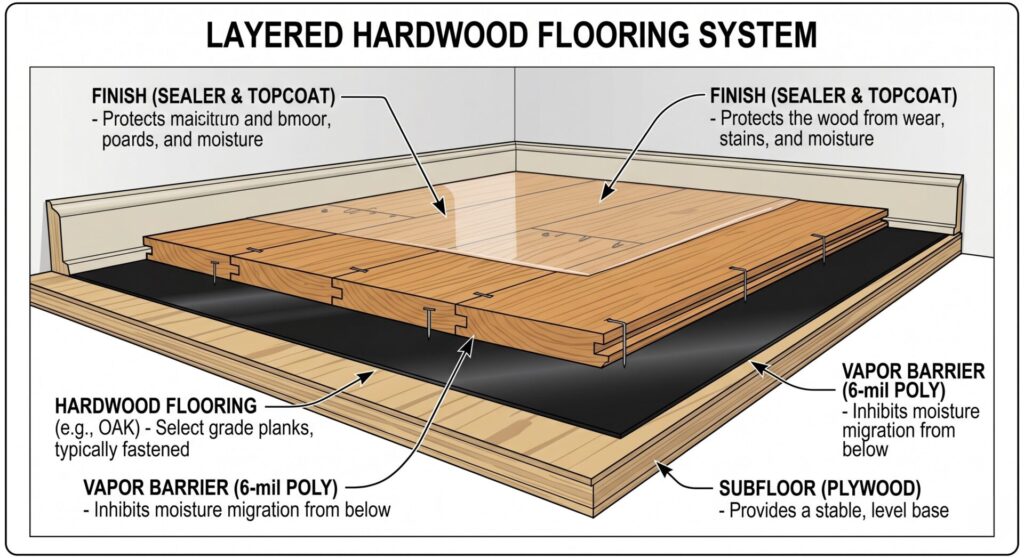
💡 Pro Tip from the Pierce Flooring Billings Team: In homes near the Yellowstone River corridor in Lockwood and areas around Pheasant Run, we consistently see subfloor moisture readings 15-20% higher than typical Billings installs. The alluvial soils in those areas hold seasonal runoff longer than the Heights or West End neighborhoods. Before we install anything in those zones, we always run a full moisture barrier assessment and typically recommend a 6-mil poly vapor barrier plus an extra 5-7 days of in-home acclimation.
“The number one thing I tell Billings homeowners is this: your home’s humidity matters more than the wood you choose. You can pick the most beautiful white oak on the floor, but if your house dries out to 18% RH every January and you haven’t addressed it, that floor is going to gap. We talk about humidifiers before we talk about species, every single time.”
— Kimberly Wynia, Store Manager, Pierce Flooring Billings
Step 1: The Consultation and Site Assessment
Good hardwood installation starts before you’ve picked a single plank. The first real step is a professional in-home measurement and site assessment, not a tape-measure exercise.
A thorough pre-install assessment covers four things: subfloor type and condition, moisture levels in both the subfloor and any existing slab, levelness, and the direction the wood grain will run relative to floor joists.
For subfloor levelness, the standard tolerance is 3/16 inch over 10 feet. For planks wider than 3 inches, the NWFA tightens this to 3/16 inch over 6 feet. Wide-plank hardwood is a popular choice in our Billings design-center projects and demands the more demanding prep.
For concrete slabs, in-situ relative humidity testing per ASTM F2170 is the current industry-preferred method, required by most manufacturers for warranty compliance. Calcium chloride testing (ASTM F1869) measures surface vapor emission and is still accepted by some manufacturers, but it is increasingly considered a secondary method.At Pierce Flooring, every project starts with a free hardwood floor measurement in Billings by a flooring project manager who knows how Billings homes are built. A 1960s ranch on the South Side has very different subfloor conditions than a new construction home in the Heights. Your installer needs to know which they’re dealing with before material gets ordered.
Step 2: Choosing the Right Hardwood for Your Home
The most common conversation we have at the showroom is about solid versus engineered hardwood. Both are real wood. The difference is structural, and in Billings, that structure is what keeps a floor performing for decades.
Hardwood flooring is also one of the stronger renovation investments in this market. According to the National Association of Realtors’ Remodeling Impact Report, new hardwood installation consistently ranks among the top five projects for cost recovery at resale, returning approximately 118% of project cost in resale value nationally. In Montana’s competitive housing market, hardwood is a genuine differentiator.
Solid Hardwood
Solid hardwood is a single piece of milled wood, typically 3/4 inch thick. It installs by nail-down over a wood subfloor and can be refinished multiple times across decades. The tradeoff: solid wood is more reactive to humidity changes.
In Billings homes with radiant heat, forced air, or south-facing rooms that dry out significantly in winter, solid hardwood can gap between boards during the dry season. That’s not a defect. It’s wood behaving like wood. Managing it comes down to species selection and indoor humidity control.
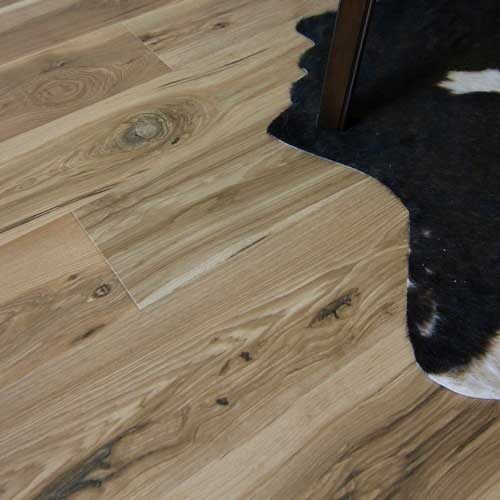
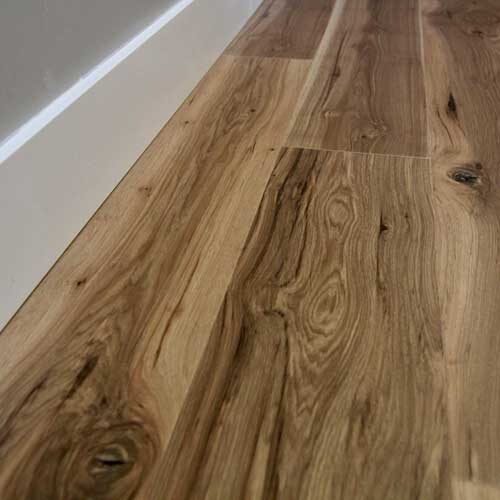
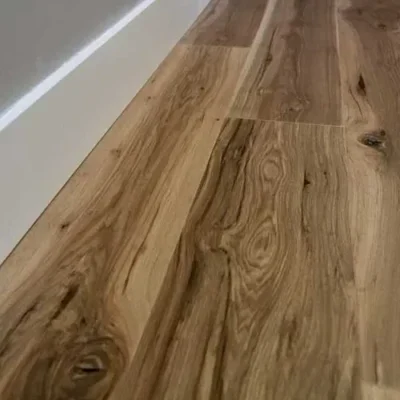
White oak handles Montana’s humidity swings particularly well. Its consistent grain structure gives it strong dimensional stability, making it one of the best domestic species for a climate like Billings. Hickory is extremely durable underfoot with a Janka hardness of 1,820, but it’s one of the more moisture-reactive domestic species and requires disciplined humidity management. If you love hickory’s look, plan on a whole-home humidifier through the heating season and indoor RH held consistently between 35-45%.
Engineered Hardwood
Engineered hardwood is constructed from a real hardwood veneer bonded over a cross-ply plywood core. That cross-ply structure makes it significantly more dimensionally stable than solid wood, which is why it’s the better choice for homes with concrete slab foundations, radiant floor heating, or below-grade installations.
Wear layer thickness is the number that determines your refinishing future. Entry-level engineered products commonly have 2-3mm wear layers, which may allow only a light screen-and-recoat. Mid-grade products at 3-4mm typically support one full sand. Premium engineered lines at 4-6mm, like those from Anderson Tuftex and DuChateau, give you the most refinishing flexibility over the floor’s life. Always ask for the published wear layer spec, not just the plank thickness.
The honest tradeoff: once you’ve exhausted your wear layer, replacement is the only option. If multi-generation refinishing matters to you, solid hardwood is still the right choice for main-level installs in Billings homes with wood subfloors.
Species Considerations for Billings Homes
Anderson Tuftex, Mohawk, Mannington, and DuChateau all carry options with documented moisture performance specs. When you come into the showroom, ask specifically about moisture-resistance ratings and the manufacturer’s published EMC (equilibrium moisture content) recommendations for high-altitude semi-arid environments. We carry these specs in-house and walk through them with every customer.
“The team walked us through every option and helped us pick an engineered hardwood that made sense for our slab foundation. They explained the humidity issue clearly. Installation was exactly as described and the floor looks incredible.”
Sarah M., West End Billings — Engineered Hardwood (Google Review: maps.app.goo.gl/ntjYF8U5uWHWDMxE8)
Step 3: What Hardwood Floor Installation Costs in Billings in 2026
Hardwood floor installation pricing in Billings tracks with national ranges, but local factors push costs in specific directions. Subfloor leveling is the most common add-on here, driven by the settling patterns in mid-century ranch homes across the South Side and Heights neighborhoods.
Old carpet removal, moisture barrier installation, and door trimming are line items that don’t always appear in a first quote but rarely disappear from a final invoice.
| Flooring Type | Material/sq ft | Labor/sq ft | Total Installed | Billings Notes |
| Solid Hardwood | $5-$15 | $4-$8 | $9-$23 | Add $1-$2/sq ft for subfloor leveling common in older Billings homes |
| Engineered Hardwood | $4-$12 | $3-$7 | $7-$19 | Best choice for slab-on-grade; handles Montana humidity swings well |
| Exotic/Premium Species | $10-$20+ | $5-$10 | $15-$30+ | Allow extra acclimation time; wider planks need longer moisture equilibration |
| Herringbone/Custom Pattern | $8-$18 | $8-$15 | $16-$33 | 15-20% more material needed; specialty skill required; plan 2-3 extra days |
Source: Regional contractor data cross-referenced with 2026 Homewyse cost estimates and Angi 2026 hardwood flooring cost data. Billings-specific notes based on Pierce Flooring project experience.
The single biggest driver of cost variation in Billings is subfloor condition. We quote every project after a physical site visit for exactly this reason. A floor that looks level to the eye can carry a 1/4-inch drop over 8 feet that requires self-leveling compound, adding $2-$4 per square foot before a single plank gets laid.
Flexible financing is available through the Pierce Financing program, including 0% promotional terms on approved credit. Ask about current offers when you visit the showroom.Want a quote built around your actual space? Schedule a free in-home consultation this week. No commitment, no pressure.
Step 4: The Acclimation Period (The Step Most People Skip)
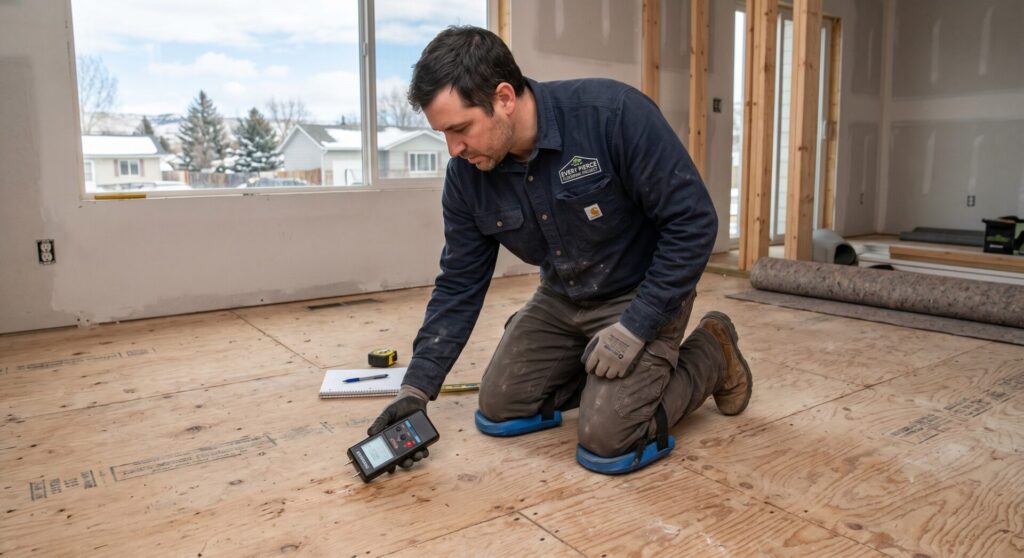
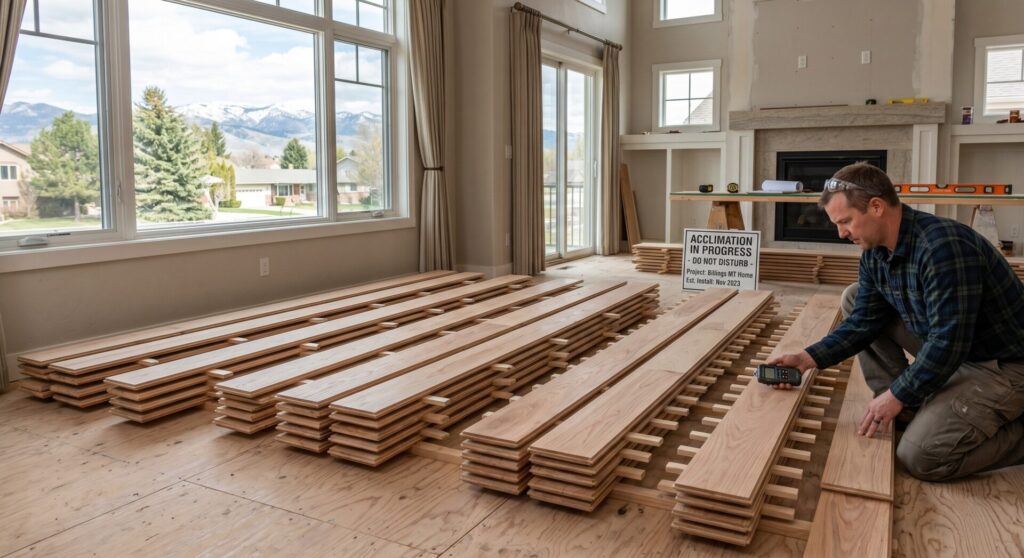
Here is where most installation problems actually start. Hardwood must acclimate to your home’s specific temperature and humidity before installation — not the climate outdoors, not a warehouse. Your home, with your HVAC running at normal occupancy conditions.
According to the NWFA installation guidelines, solid hardwood typically requires 3-7 days of acclimation in the installation space with the HVAC operating at normal living conditions. In Billings homes that have been closed up during winter or are being prepped for a spring move-in, we often extend that window to 7-10 days because the home’s internal humidity can be significantly off from its normal occupied state.
What does proper acclimation actually look like? The boxes of flooring are opened and either stickered — boards separated with air gaps — or laid flat in the room where they’ll be installed. A moisture meter tracks board moisture content until it reaches equilibrium with the subfloor.
For solid hardwood, the target differential between the wood and the subfloor is no more than 2%. For engineered hardwood, the NWFA defers to individual manufacturer specifications. Most published guides specify 2-4%, so always confirm the tolerance for your specific product before installation begins. This is not a formality. It is the physical foundation for everything that follows.
⚠️ Red Flag: Any installer who shows up on delivery day and wants to start nailing immediately should stop you. Same-day installation of newly delivered wood is one of the leading causes of gapping and cupping failures in Billings homes.
“Highly professional team from start to finish. They measured, helped us pick a beautiful hickory floor, and the installation crew was efficient and cleaned up completely. Very happy with the whole experience.”
Dave R., Heights Billings — Solid Hardwood (Google Review: maps.app.goo.gl/ntjYF8U5uWHWDMxE8)
Know enough already? Our project managers are available for free in-home assessments, no obligation, just a professional second opinion on your subfloor before you commit to anything.Schedule your free subfloor assessment or call (406) 652-4666.
Step 5: Subfloor Preparation
Subfloor prep is where the real labor lives. Think of the subfloor as the foundation of a house within a house: every imperfection you leave behind will eventually show up in the finished floor above it. A clean, dry, flat, and structurally sound subfloor is non-negotiable, and each of those four words means something specific.
Clean: Old adhesive, paint drips, staples from previous carpet, and debris all need to be removed. Residual adhesive from vinyl or tile can prevent proper bonding for glue-down applications and create high spots for nail-down.
Dry: Moisture meter readings must confirm the subfloor is within acceptable range. For plywood subfloors, the NWFA recommends a maximum of 12% moisture content. For concrete slabs, in-situ relative humidity testing per ASTM F2170 is the manufacturer-preferred standard for warranty compliance.
Flat: The standard tolerance is 3/16 inch over 10 feet. For planks wider than 3 inches, the NWFA requires 3/16 inch over 6 feet. Self-leveling compound handles low spots; high spots are ground down. This work determines whether your floor feels solid or hollow underfoot five years from now.Structurally sound: Squeaky subfloor panels get additional fasteners. Any soft spots are investigated. In Billings homes from the 1950s-1970s, we occasionally find rot or water damage at sill plates near exterior walls, and that gets addressed before anything else.
Step 6: Installation Methods
The installation method that’s right for your home depends on your subfloor type, the species of wood, and plank dimensions. Here are the three primary methods.
Nail-Down (Staple-Down)
The traditional method for solid hardwood over plywood subfloors. A pneumatic nailer or floor stapler drives fasteners through the tongue of each board at a 45-degree angle, a technique called blind nailing because the fastener head is hidden beneath the next plank, leaving no visible hardware on the finished surface.
Most domestic species install at 6-8 inch fastener spacing, but harder or more brittle woods like hickory and Brazilian cherry typically require 4-6 inch spacing to protect the tongue from cracking. Always confirm spacing with the manufacturer’s published installation guide for your specific species and plank width.
🪵 What Is Racking Out — and Why It Matters: One step that separates experienced installers from rushed ones is racking out the floor before a single board is fastened. This means laying out several rows of planks dry — without adhesive or fasteners — and mixing boards from multiple boxes to distribute color variation and end-joint lengths across the room. A floor that isn’t racked properly ends up with visible color banding or a repeating pattern of short end-joints that breaks up the natural flow of the wood. Ask your installer when they plan to rack the floor. If they don’t know what you’re referring to, that’s useful information.
Glue-Down
Used primarily for engineered hardwood over concrete slabs. The installer applies a troweled adhesive to the substrate in sections, then presses planks directly into it. Proper trowel notch size and timing are both critical.
Open time is how long the adhesive stays workable in the trowel notch. Working time is how long you have to set the plank and achieve full transfer before the adhesive skins. In a Billings summer at 40% indoor humidity, open time can shrink dramatically. Adhesive failures almost always trace back to wrong trowel size or planks laid after the adhesive has begun to skin.
Floating
Boards click together without adhesive or fasteners, resting on a foam or cork underlayment. Appropriate for engineered hardwood in specific applications, but not the first-choice method for high-traffic areas or homes with radiant heat.
Because the entire floor field expands and contracts together, insufficient perimeter gaps or missing relief cuts in large open-plan spaces can cause buckling or tenting in summer. In a Billings home with seasonal humidity swings, expansion gap management is non-negotiable for floating installations. Floating floors can also feel slightly hollow underfoot compared to nail-down.
Step 7: Final Details, Transitions, and Finishing
Door casings need to be undercut to allow flooring to slide underneath rather than butting up against the trim. An installer who skips this step will use quarter-round or base shoe to cover the gap, which works but doesn’t look as clean. Ask whether door casing undercutting is included in your quote.
Expansion gaps of 1/2 to 3/4 inch must be maintained at every wall, HVAC register, and fixed object. These gaps are covered by base molding or threshold transitions and are invisible in the finished room. They’re the reason hardwood doesn’t buckle when summer humidity pushes the boards toward each other.
Transitions between hardwood and other floor types, stair nosing, and reducer strips all need to be selected and ordered before installation day. This detail delays more projects than any other. Your project manager should confirm all transition pieces are on-site before the crew arrives.
Living With Your Hardwood Floor Through Billings Seasons
The maintenance conversation most installers skip is about humidity management. In Billings, you need it going both directions. In winter, when forced air heating dries your home to 20-25% indoor relative humidity, wood floors can gap visibly. A whole-home humidifier that holds 35-45% RH through the heating season protects your floor investment better than any cleaning product.
In spring, as the Yellowstone drainage brings moisture into the region and Billings humidity climbs back toward 60-70%, the floors respond by expanding. This is normal. Visible gaps in winter that close in spring are not a product defect. They are seasonal wood movement doing exactly what it should.
Cleaning is straightforward: dry or slightly damp microfiber mop with a pH-neutral hardwood floor cleaner, never a wet mop, and never alkaline household cleaners. Many products labeled ‘hardwood safe’ run pH 8-10 and will dull or haze a polyurethane or aluminum oxide finish within 12-18 months of regular use. pH-neutral is the single most protective cleaning habit for any hardwood floor.
Area rugs in high-traffic zones work well, but wait at least 30 days after installation before placing rubber-backed rugs. They can trap off-gassing from new finishes and cause permanent discoloration or adhesion issues. Felt pads under furniture legs and avoiding high heels on finished hardwood will add years to the floor’s life.
According to the NWFA, a standard 3/4-inch solid hardwood floor can typically be refinished 4-5 times over its life. Plan the timeline by starting with the finish, not the calendar.
A smarter approach for most homeowners: schedule a screen-and-recoat every 3-5 years in high-traffic areas. This light abrasion and fresh topcoat costs a fraction of a full refinish and can push your full sand cycle back by a decade.
Many well-maintained Billings floors never need a full refinish within a family’s occupancy. Plan on a full sand-and-refinish every 10-15 years only when the wear layer no longer supports a screen-and-recoat.
“People ask me all the time why their floors look dull after a couple of years. Nine times out of ten it’s the cleaner. They’ve been using a spray bottle product that smells like hardwood cleaner but runs alkaline. It’s been slowly breaking down the finish with every use. Switching to pH-neutral and doing a screen-and-recoat gets them back to new. It’s a two-hour job and it transforms the room.”
— Kimberly Wynia, Store Manager, Pierce Flooring Billings
How to Choose a Hardwood Flooring Installer in Montana
The hardwood floor installation process is only as good as the installer executing it. Here’s a practical checklist for vetting any contractor in the Billings area:
- Ask if they conduct a site assessment before pricing. Any quote issued without an in-person visit to your specific subfloor is a guess, not a price.
- Ask how they measure subfloor moisture. A legitimate installer owns and uses a moisture meter. For concrete slabs, ask specifically whether they use in-situ RH testing per ASTM F2170.
- Ask about their racking-out protocol. How do they distribute color and end-joint variation across the room? A blank look in response to this question tells you something important.
- Ask for the specific installation method they recommend for your subfloor type and why. Correct answers reference your subfloor material, species being installed, and plank dimensions.
- Ask about acclimation protocol. How many days? How do they sticker or stage the material? For engineered: do they confirm the manufacturer’s published EMC tolerance?
- Check for manufacturer-certified installers. Brands like Anderson Tuftex and Mohawk offer training programs that verify the installer knows the specific product.
- Ask about the warranty on labor. Look for at least 1 year on installation workmanship, separate from any product warranty.
Red flags in a quote: no in-person site visit required, no mention of subfloor moisture testing, same-day installation timeline, or warranty language that covers materials only and not labor.
The Pierce Promise covers installation errors for 1 year and backs manufacturer warranties for the life of the product. Our project managers conduct every site assessment personally and follow NWFA installation protocols on every project.
Frequently Asked Questions
How much does hardwood floor installation cost in Billings, MT in 2026?
Most Billings homeowners pay between $9 and $23 per square foot installed for solid hardwood and $7 to $19 for engineered. Mid-range solid hardwood in a typical Billings home runs $10,000-$16,000 for a 1,000-square-foot space. Local factors that push cost upward include subfloor leveling in older neighborhoods ($2-$4 per square foot), moisture barrier installation on slab foundations ($0.50-$1.50 per square foot), and complex layouts or herringbone patterns (add $8-$15 per square foot in labor). Get an in-person quote to price your specific subfloor conditions accurately.
How long does wood need to acclimate before installation in Billings?
Solid hardwood typically needs 5-10 days in a Billings home with HVAC running at normal occupancy conditions. Engineered hardwood generally requires 3-5 days. Homes that have been vacant, recently renovated, or heated at reduced temperatures may need the longer end of that range. For solid hardwood, the target is wood moisture content within 2% of the subfloor reading. For engineered, confirm the specific tolerance published by your product manufacturer, as most fall in the 2-4% range.
Is it normal for new hardwood floors to creak or have gaps?
It depends on the type of creaking. Small seasonal gaps in winter and minor creaking during temperature transitions are normal in Billings homes. The city’s 36-point annual humidity swing causes wood to expand and contract every year, and gaps that open in December and close in April are wood doing exactly what it should. Persistent loud creaking that doesn’t track with seasonal changes, or gaps that fail to close as spring humidity rises, are different. Those can indicate subfloor movement or a missed moisture issue at install time and warrant a follow-up assessment.
Can hardwood be installed over existing tile or vinyl in Billings homes?
Hardwood can be installed over existing tile if the tile is fully adhered, flat, and grout lines are filled or accounted for in leveling. Floating engineered hardwood is the most practical method in that scenario. Solid nail-down over tile is generally not recommended because the tile prevents proper fastener penetration into the subfloor. A thorough site assessment will determine whether direct installation is practical or whether removal is the better long-term decision.
What’s the biggest mistake homeowners make when planning a hardwood floor project?
Choosing a product before scheduling a site assessment. The wood you love in the showroom has to work with your specific subfloor, your home’s moisture conditions, your HVAC system, and your lifestyle. A stunning wide-plank white oak engineered floor that’s perfect in a radiant-heated home can be a poor choice in a Billings ranch with forced air and no whole-home humidifier. The consultation comes first. The product selection follows.
Talk to a Project Manager This Week
The subfloor condition in your home is something we can only assess in person. Every project manager on our Billings team has worked through dozens of South Side ranches, Heights new builds, and Lockwood slabs, and that field experience is what makes the difference between a quote and a plan.
Pierce Flooring & Cabinet Design Center. 2950 King Ave W, Billings, MT 59102. (406) 652-4666.
Stop in any day this week. No appointment needed. Schedule your free in-home measurement online and a project manager will come to you.Not ready to commit? Use our Room Visualizer to see how different hardwood species look in your actual room before you set foot in the showroom.
You Might Also Like
-

- Flooring
October 7, 2026
Commercial Flooring in Billings: What Property Managers and Business Owners Need to Know
-
- Flooring
September 16, 2026
Flooring for New Homes in Ennis and the Madison Valley: What Builders and Homeowners Need to Know
-
- Flooring
August 25, 2026
What Does Waterproof Flooring Actually Mean? A Montana Homeowner’s Guide to LVP Claims
Ready to Transform Your Home?
Contact Us Today to Get Started on Your Dream Space