- Flooring
5 Signs It’s Time to Replace Your Flooring — And What Montana Winters Do to Speed It Up
March 13, 2026
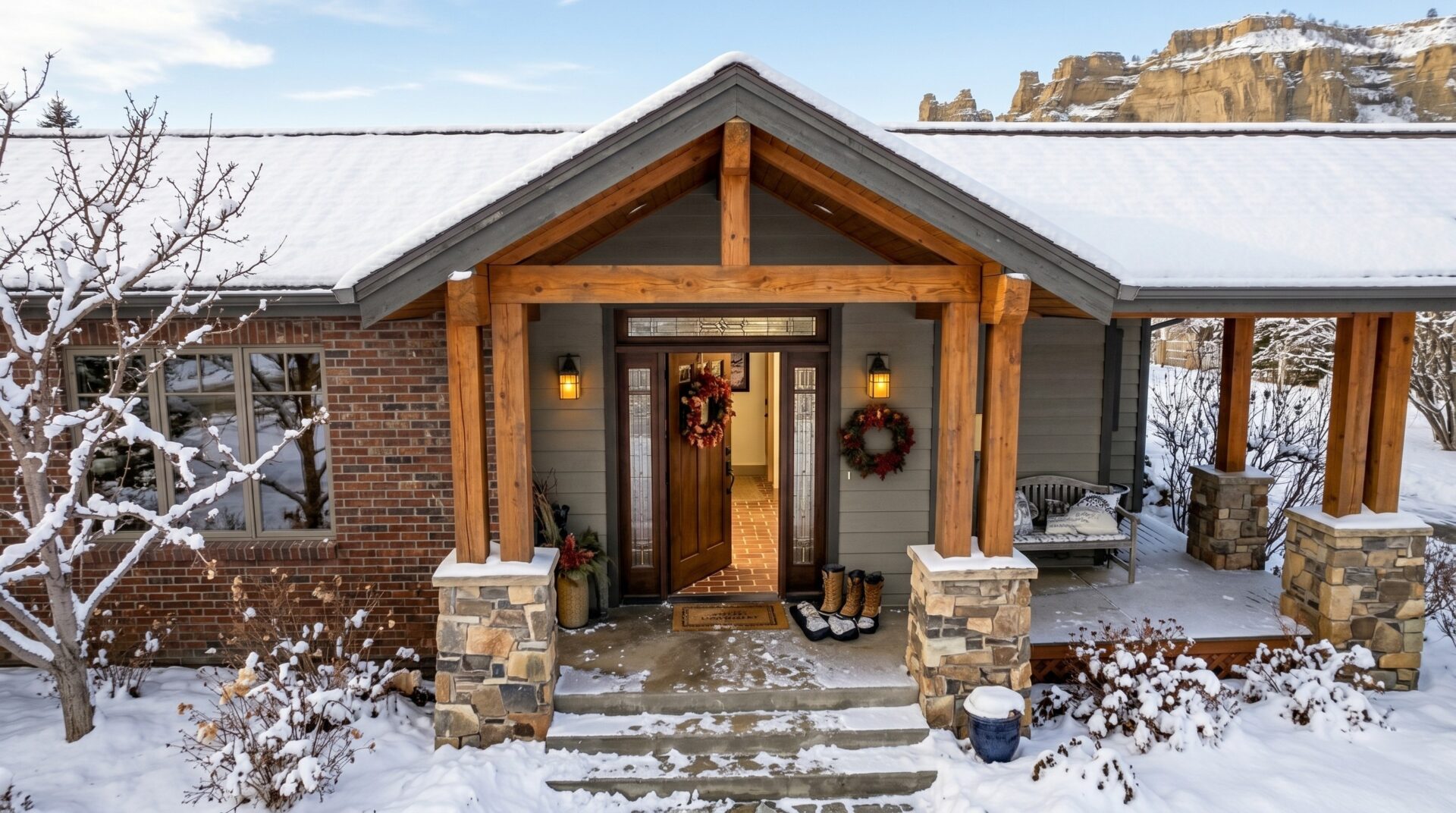
Last winter, a Billings homeowner called us after noticing a gap between two hardwood planks wide enough to trap a quarter. By the time we visited, the subfloor beneath had been absorbing snowmelt from the entryway for two seasons. The floor wasn’t just failing. It had already failed.
This is the most common flooring replacement story we hear in Montana, and it almost always starts with a sign the homeowner saw and waited on. This guide covers five concrete signs your floors need replacing, not just patching. If you’re already asking the question, it’s worth getting a straight answer before the next winter sets in.
Schedule a free in-home consultation with the Pierce Flooring team, or call us at (406) 652-4666. We’ve been serving Montana homeowners since 1924.
Why Montana’s Climate Destroys Floors Faster Than Most States
Understanding what works against your floors every day in Billings is the starting point for knowing when to act.
The humidity swing is the real culprit. In January, average relative humidity climbs to around 76%. By August, it drops as low as 40%. That 36-point seasonal swing forces every material in your home to expand and contract, including your subfloor, your flooring, and the adhesive or fasteners holding it together. Most hardwood tolerates indoor humidity between 35% and 55%, according to the National Wood Flooring Association. Billings blows past both ends of that range without a well-managed HVAC system and a humidifier.
Temperature is the second problem. The average annual temperature variation in Billings exceeds 51°F from peak winter to peak summer. For materials like laminate and luxury vinyl plank, that kind of thermal range is like running a rubber band through a freeze-thaw cycle every year. Eventually it loses its shape. The UV index at Billings’ elevation also compounds fading and surface breakdown faster than coastal climates.
Snow melt is the third. Entryway flooring in Billings homes takes a beating from tracked-in snow, road salt, and the freeze-thaw moisture cycle that runs from October through April. Salt residue left on hardwood oxidizes the finish and bleaches the color out of the grain. Over time, that moisture migrates down to the subfloor, and once a subfloor gets wet repeatedly, you’re no longer just replacing flooring.
According to the NWFA, hardwood floors in low-humidity environments experience accelerated dimensional stress. Billings’ dry summers combined with heated-air winters create exactly that cycle. Without active humidity management, Montana hardwood floors often show signs of permanent movement within 10 to 15 years that properly managed floors in moderate climates avoid for 25 to 30.
Pro Tip — Pierce Flooring Billings Team: In neighborhoods with older slab construction, like parts of the Heights or West End, we routinely find subfloor moisture readings well above acceptable ranges before we’ve even pulled up the existing floor. If your home was built before 1980 and you’ve never had a subfloor moisture assessment, that’s the first step, not a product selection. We run that assessment at no charge as part of your free in-home measurement.
Sign 1: Shifting, Clicking, or Hollow Spots — Subfloor Failure Signs in Montana Homes
Walk across your hardwood or laminate barefoot. Do you feel boards shifting slightly underfoot? Do you hear a hollow sound when you step on specific sections?
That clicking or clunking isn’t the floor “settling.” It’s the subfloor. In Billings, the most common cause is repeated moisture exposure working its way under the floor through entryways, around plumbing fixtures, or up from below-grade spaces.
When a subfloor gets wet and dries repeatedly, it loses structural integrity. The fasteners that hold planks in place start to fail. Floating floors begin to separate at the interlocking edges.
What to look for:
- Boards that shift, rock, or flex when you stand on them
- A hollow sound when you tap specific areas
- Visible gaps opening between planks, especially in winter when humidity is lowest
- Laminate or LVP seams that have separated along the locking edges
Movement in a floor is the sign most homeowners wait too long on. Once the subfloor is compromised, you’re not replacing one floor. You’re replacing two.
If you’ve noticed any movement, reach out to the Pierce Flooring team before it gets worse. Our project managers include a full subfloor assessment, including a moisture test, as part of every free in-home visit.
Sign 2: Cupping, Buckling, and Mold Smell — Moisture Damage Signs That Mean Replace, Not Repair
Cupping is when hardwood boards bow upward at the edges, creating a concave shape across the surface. Crowning is the opposite, where the center of each board humps upward. Both are moisture responses.
In Montana, cupping is common in winter when indoor humidity spikes. Crowning often follows poorly executed repairs or a wet installation where one face of the board dries faster than the other. Attempting to sand a crowned floor without first measuring moisture content typically makes the problem worse. This is one case where a professional assessment must come before any remediation.
Visible warping in LVP or laminate is a related but different failure mode. These products are far more moisture-tolerant than solid hardwood, but they’re not immune. Laminate with a swollen core around a baseboard is telling you water got in and stayed. LVP bubbling at seams typically points to moisture from the subfloor or an insufficient expansion gap, both of which are common in Montana’s extreme temperature swings.
The smell test matters, too. Old carpet in a Billings home that has seen pets, spilled liquids, or repeated snowmelt dragged in from boots will retain odors in the backing and padding regardless of surface cleaning. If professional carpet cleaning doesn’t resolve a persistent odor, the source is almost always the pad. Once the pad is saturated, replacement is the only real fix.
Moisture-related signs that point to replacement over repair:
- Cupping or crowning that covers more than a small isolated section
- White salt staining on wood near entryways that won’t clean off
- Bubbling or lifting at laminate or LVP seams
- Musty odors that return after cleaning
- Soft spots in any flooring near plumbing, exterior walls, or below-grade rooms
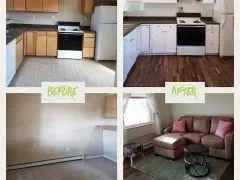
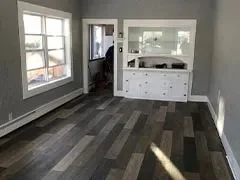
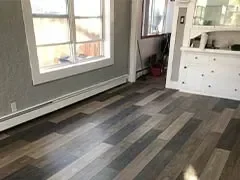
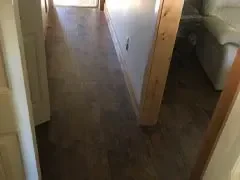
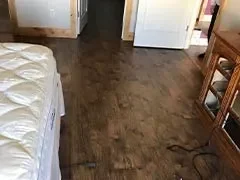
“The office staff was friendly and answered all our questions. Ryan and Dexter were great. They were efficient and finished in a timely manner with good follow up to make sure all was right. I appreciated how they cleaned up when they finished. Of course we love the new floor! The photos are linoleum before to LVP after!” — Billings Homeowner, Linoleum to LVP Replacement, via pierceflooring.com
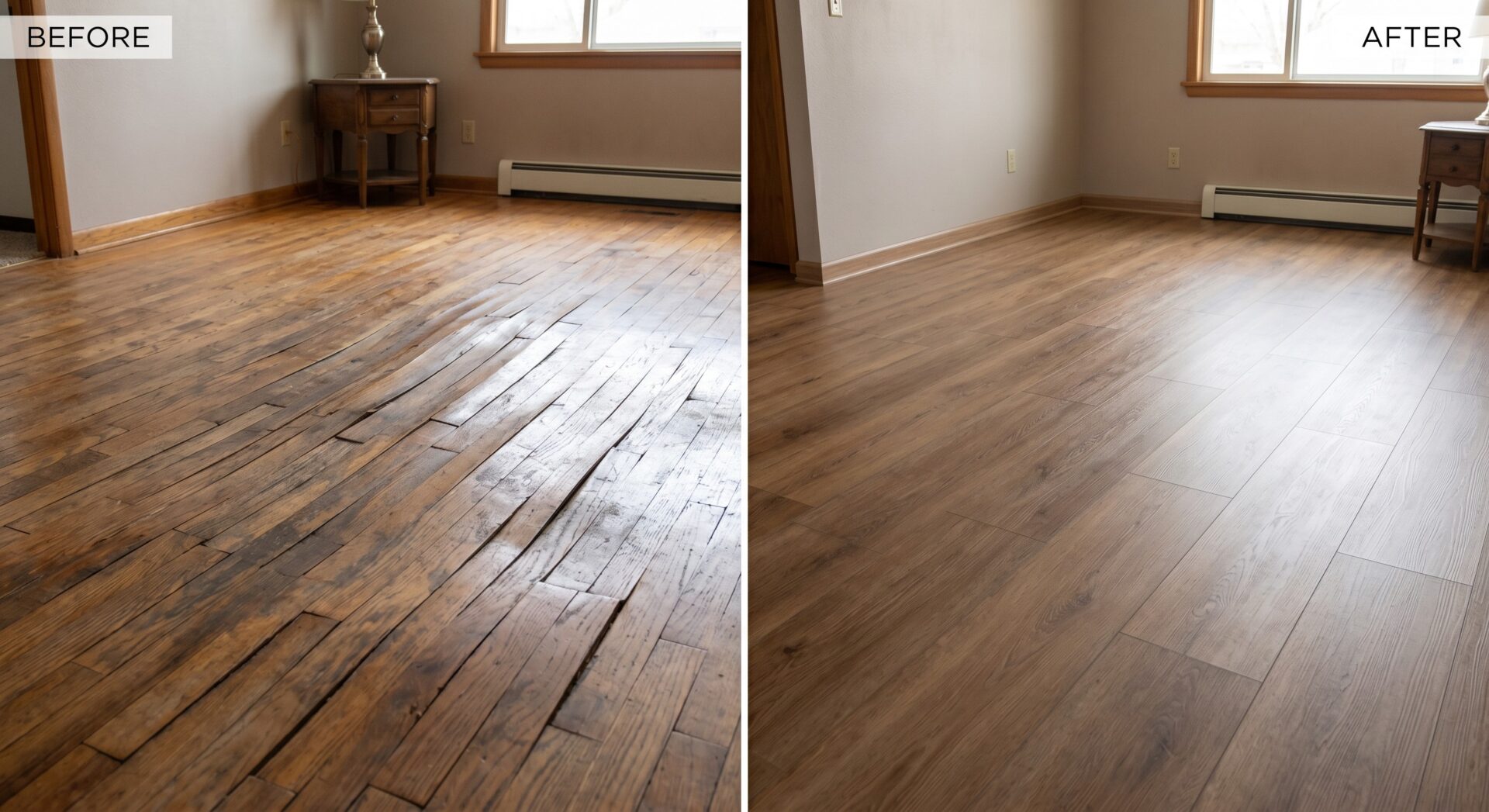
If you want to see what moisture-resistant flooring options look like in your actual space, the Roomvo visualizer on our website lets you upload a photo of your room and preview products before committing.
Sign 3: When Hardwood Floors Can’t Be Refinished Again — Replacement vs. Refinishing in Montana
Solid hardwood is the most refinishable flooring material on the market, but it’s not infinitely refinishable. Each full refinish cycle removes roughly 1/32″ of material from the surface. Most 3/4″ solid hardwood floors have enough thickness above the tongue to support four to five refinishes over a lifetime.
Think of it like sharpening a knife: you can only remove so much metal before the blade is gone. Once the material above the tongue is depleted, sanding further risks exposing fastener heads, and at that point, refinishing does more damage than good.
During a free in-home measurement, one of the first things our project managers check on hardwood is whether the floor has any remaining refinish cycles. That assessment looks at overall plank thickness, the presence of visible nail heads beginning to surface, and the condition of the stain layer. Your project manager will walk through exactly what they find, with no commitment required.
If your floor has been sanded multiple times and still shows deep gouges or surface irregularities no amount of finishing will correct, replacement is the professional recommendation, not another pass with the sander.
Engineered hardwood has a thinner veneer wear layer, typically 2mm to 6mm depending on the product, which limits sanding to one or two passes. If your engineered floor shows wear through to the core layer, refinishing is off the table entirely.
For Billings homes built on slab-on-grade construction, common in the Heights and parts of the West End, engineered hardwood is almost always the right call over solid hardwood for replacement. The multi-layer construction handles moisture migration from below-grade slabs significantly better than solid planks, which can cup repeatedly and permanently in that environment.
“The question we ask every customer with hardwood is: can you see the nail? If you can see fastener heads in a floor that looks otherwise good, that’s the last refinish cycle. We can work with that. But if you’re seeing the nail AND the surface is showing wear through the stain layer, we’re talking replacement.” — Pierce Flooring Billings Team
Sign 4: Worn LVP Wear Layer, Matted Carpet, and Crumbling Grout — When Cleaning Isn’t Enough
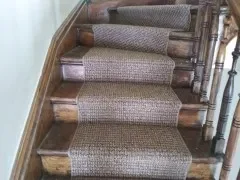
Worn carpet in a heavily trafficked hallway looks matted and flattened. The pile has been crushed beyond recovery. Vacuuming and professional cleaning restore appearance in lightly used areas, but once the carpet fiber itself has broken down from foot traffic, no cleaning process restores the pile height or texture.
The same logic applies to tile and LVP. Crumbling grout lines in a tile floor aren’t purely cosmetic. They’re entry points for moisture and a structural failure signal.
If the tile itself sounds hollow when tapped, the adhesive beneath has failed. In a heated mudroom or bathroom that sees heavy use, re-grouting a floor with failed adhesive is a temporary fix at best.
LVP has a wear layer rating measured in mils, a unit equal to 1/1000 of an inch. Most residential-grade LVP runs 12 mil to 20 mil. A worn wear layer shows up as a visible dullness that doesn’t clean away, or as a texture shift where the embossing has been polished smooth from foot traffic.
A quality 20-mil LVP in a Montana home typically maintains its wear layer for 15 to 25 years under normal residential foot traffic, provided it’s cleaned with pH-neutral products and kept out of sustained standing water. Once the wear layer depletes, the rigid core beneath is exposed. Most manufacturer warranties are structured around surface wear reaching that threshold, so if your LVP is showing significant dullness or texture loss, get a professional assessment before assuming you’re still under coverage.
The Resilient Floor Covering Institute recommends verifying that any LVP product meets ASTM F1700 or F3261 standards. Both are indicators of consistent wear layer quality and dimensional stability under the kind of temperature variation Montana delivers year-round.
In 2026, outdated aesthetics are also a legitimate replacement trigger. High-gloss floors that show every footprint, honey oak from the 1990s, and grey LVP that flooded the market five years ago are all being replaced by Montana homeowners updating toward warmer, matte finishes and wider planks in natural wood tones. Flooring style affects how homes photograph and how buyers perceive value at first showing.
“I had some old worn out carpet in my basement and it was long overdue to be replaced. I called Pierce and was given over to Joe, who was extremely helpful with both the information he gave me, but also the options that I had. After he came by and measured the area, he got back to me within two days with a complete quote and product that matched perfectly. I had them install the new floor the very next week, and am truly glad I did.” — Bozeman Homeowner, Carpet Replacement, via Angi
For a wider look at what works in smaller Montana rooms, that post covers layout and product choices that make a real visual difference.
Sign 5: Outdated Flooring Hurting Your Montana Home’s Resale Value
Uneven floors are a tripping hazard. A tile that’s lifted a quarter inch, a laminate transition strip buckled above the subfloor, or a carpet edge that’s come loose at a doorway, these are fall risks, especially in homes with children or older adults. This one sounds simple, but it’s underestimated.
Beyond safety, there’s the question of home equity. Montana’s competitive real estate markets, including Bozeman, Missoula, and a fast-moving Billings market that has attracted out-of-state buyers, are ones where flooring is one of the first things prospective buyers notice during showings. Worn carpet, chipped tile, and scratched hardwood all factor into offers.
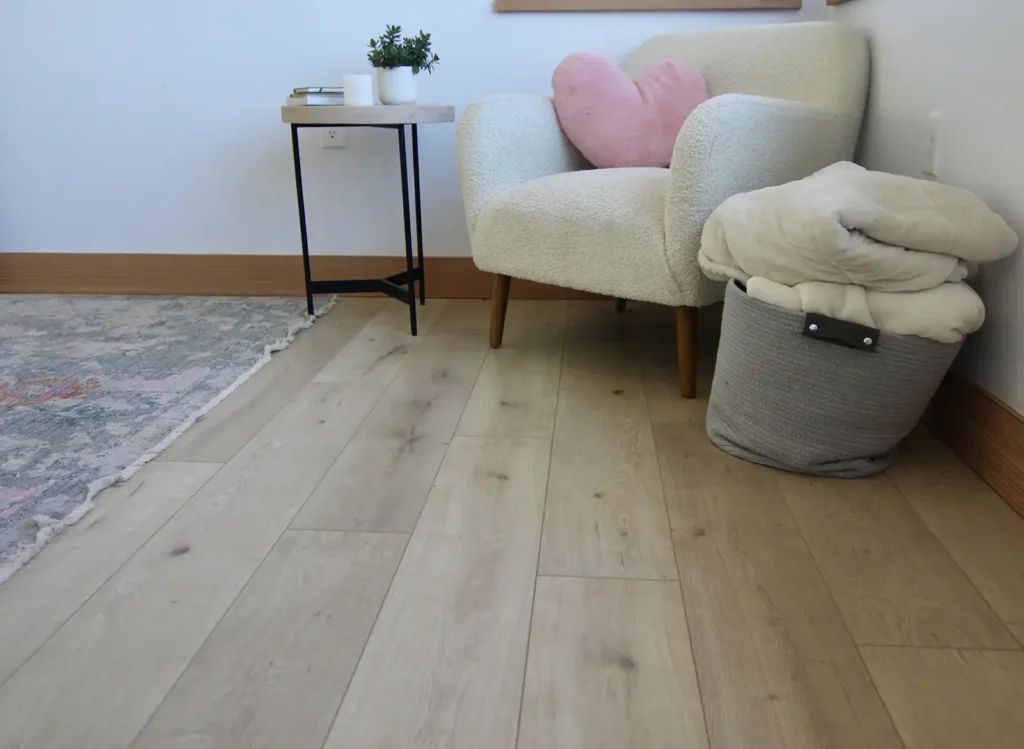
LVP and engineered hardwood tend to offer the strongest combination of durability, broad buyer appeal, and installed cost relative to return value in Montana’s current market. Wide-plank formats in warm, natural tones are driving most replacement projects we’re seeing in 2026.
For LVP specifically, ask your installer what expansion gap they’re leaving and why. In a Montana home that swings 40-plus degrees seasonally, leaving the full gap specified by the manufacturer, and sometimes slightly more, is what separates a floor that performs for 20 years from one that starts buckling in its second October.
What Does Flooring Replacement Cost in Billings, Bozeman, and Missoula in 2026?
Here’s what flooring replacement costs installed, including labor. Prices vary based on subfloor condition, room complexity, and specific product selection.
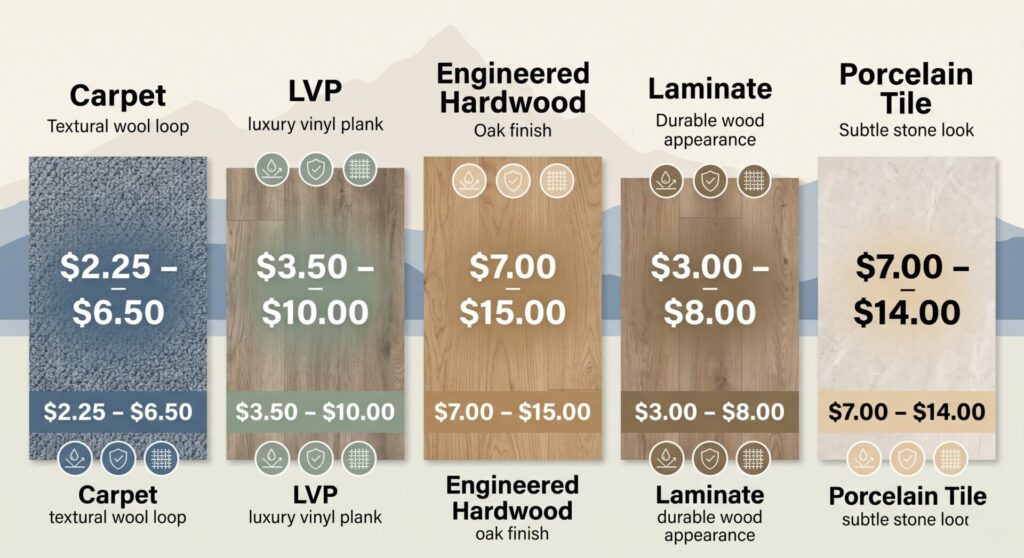
Montana Flooring Replacement Cost Guide — Updated March 2026 | Source: Regional contractor data and RSMeans Montana cost data
| Flooring Type | Material (per sq ft) | Labor (per sq ft) | Total Installed | Montana Notes |
|---|---|---|---|---|
| Carpet | $1.50 – $5.00 | $0.75 – $1.50 | $2.25 – $6.50 | Pad quality matters; budget for pad upgrade |
| Luxury Vinyl Plank | $2.00 – $7.00 | $1.50 – $3.00 | $3.50 – $10.00 | Subfloor prep often adds cost on older slabs |
| Engineered Hardwood | $4.00 – $10.00 | $3.00 – $5.00 | $7.00 – $15.00 | Preferred over solid hardwood on slab construction |
| Laminate | $1.50 – $5.00 | $1.50 – $3.00 | $3.00 – $8.00 | Waterproof core essential for Montana |
| Ceramic / Porcelain Tile | $2.00 – $6.00 | $5.00 – $8.00 | $7.00 – $14.00 | Most common for mudrooms and bathrooms |
| Natural Stone Tile | $6.00 – $15.00+ | $7.00 – $10.00 | $13.00 – $25.00+ | Radiant heat adds cost; highly variable by stone |
| Solid Hardwood | $5.00 – $12.00 | $4.00 – $6.00 | $9.00 – $18.00 | Humidity management non-negotiable |
What drives price variation in Billings specifically: subfloor condition on older construction in the Heights and West End areas, winter scheduling that can extend lead times, and the added cost of moisture barrier or subfloor leveling work that’s more common here than in drier or more temperate climates.
Want a quote built around your actual space? Visit our showroom this week or call (406) 652-4666 for a free estimate.
Montana Floor Care by Season: What You’re Probably Getting Wrong
Most flooring guides aren’t written for a climate that hits 76% humidity in January and 40% in August. Montana requires a different maintenance calendar.
Winter (Oct – Mar): This is your highest-risk period for moisture damage. Put entry mats at every exterior door and change them frequently. A saturated mat concentrates moisture in one spot, which is worse than no mat at all. After heavy snow events, lift the mat and let the floor surface dry before replacing it.
Run a humidifier and monitor with an inexpensive hygrometer. Your target is 35 to 55% relative humidity year-round. Montana homes with forced-air gas heat can drop below 25% in January, which is outside the safe range for any wood-based flooring product.
Spring melt (Mar – May): The freeze-thaw cycle makes this the most unpredictable window for water intrusion. Check basement and below-grade spaces for moisture migration. This is also the right time to address any subfloor concerns before summer renovation season begins.
Summer (Jun – Aug): Humidity drops sharply. Hardwood gaps are most visible in summer, which is normal seasonal movement. If gaps persist or widen year over year, that’s cumulative dimensional loss, a sign the floor is failing.
Use window coverings on south and west-facing rooms to limit UV exposure and surface temperature on LVP and laminate. According to the NWFA, consistent indoor humidity is the single most effective thing a Montana homeowner can do to extend hardwood floor life.
The maintenance mistake we see most often: steam mops on hardwood or laminate. Steam forces moisture into the core and locks seams at an elevated temperature. The damage doesn’t show up immediately. It surfaces six months later as warped edges and swollen seams.
For all hard-surface floors, use pH-neutral cleaners only. High-alkalinity or high-acidity products degrade the wear layer finish over time and can void the manufacturer’s warranty.
Montana Floor Care by Season: Quick Reference Guide
| Season | DO | DON’T |
|---|---|---|
| Winter (Oct–Mar) | Use entry mats, run a humidifier, target 35–55% RH with a hygrometer | Use steam mops, let wet mats sit on hardwood, skip humidity monitoring |
| Spring Melt (Mar–May) | Check below-grade spaces for moisture, schedule subfloor assessment | Wait on visible cupping — it worsens with each freeze-thaw cycle |
| Summer (Jun–Aug) | Use window coverings on south/west windows, pH-neutral cleaners only | Use alkaline cleaners, ignore widening hardwood gaps year-over-year |
Save this guide or share it with someone planning a Montana home project.
How to Choose a Flooring Installer in Montana
Whether you work with Pierce Flooring or anyone else, these are the questions that separate professional installers from those cutting corners.
Before any quote is finalized, ask:
- Will you come to the site in person before quoting? Any quote given without a site visit is a guess.
- Will you run a moisture test on my subfloor? Skipping this is the most common installer shortcut in Montana, and it’s how moisture damage gets locked in under a new floor.
- What’s your process if subfloor prep is needed? Do you handle leveling in-house?
- What does your installation warranty cover, and for how long?
- Are your installers licensed and insured?
Red flags in a quote:
- No in-person measurement before pricing
- No mention of subfloor assessment or moisture testing
- Vague warranty language about what “installation errors” actually covers
- A timeline that seems too fast for the scope of work. Rushing acclimation for solid hardwood is a real problem (acclimation requirements for engineered products vary by manufacturer; your project manager will confirm based on the specific product selected)
At Pierce Flooring, every project starts with a free in-home measurement by a flooring project manager, not a sales appointment, an actual site assessment. Our Pierce Promise covers installation errors for one year following completion, and we act as your advocate with the manufacturer on product warranty issues for the life of the floor.
FAQ: Flooring Replacement in Montana
What’s the biggest mistake homeowners make when replacing flooring?
Choosing product before assessing the subfloor. A beautiful engineered hardwood floor installed over a subfloor with unresolved moisture issues will fail in ways the manufacturer’s warranty won’t cover, and the homeowner ends up paying for a second replacement. In Montana, where subfloor moisture variation is significant, the floor inspection comes first. Your project manager will check subfloor moisture as the very first step of every free in-home visit.
How much does it cost to replace flooring in a typical Montana home?
For a mid-size living room around 300 square feet, budget roughly $1,000 to $3,000 for carpet, $1,200 to $3,500 for LVP, or $2,500 to $5,500 for engineered hardwood, all installed. Subfloor work, if needed, adds $1 to $3 per square foot. Older homes often require subfloor prep that isn’t visible until the old floor comes up. Call us at (406) 652-4666 for a quote specific to your home.
Does Montana’s climate make certain flooring types a poor choice?
Yes. Solid hardwood requires whole-home humidity management and is the most climate-sensitive material you can install in a Montana home. For slab-on-grade construction common in Billings, engineered hardwood is almost always the better call, and LVP with a 20-mil wear layer is the most forgiving option for rooms with frequent snowmelt exposure. Our team will recommend the right material for your specific construction type during your free consultation.
What does the process look like from first call to finished floor at Pierce Flooring?
You schedule a free in-home measurement, a project manager visits your space to assess the subfloor and take measurements, and you finalize product selection in the showroom or via our Room Visualizer online. We order material, confirm manufacturer-required acclimation, and schedule installation. Most residential jobs complete in one to two days, and the Pierce Promise covers installation issues post-completion. Schedule at pierceflooring.com or call (406) 652-4666.
How do I know when carpet needs replacing versus just deep cleaning?
Run your hand across the carpet pile in a high-traffic area. If the fibers don’t spring back, the pile is permanently crushed and cleaning won’t restore texture. Odors that return within days of professional cleaning are coming from the pad, not the surface, and that points to replacement.
Visible staining that won’t lift, UV fading near windows, or wrinkling from a loose backing are also replacement indicators. If you’re unsure, let a project manager take a look at no charge.

Ready to Replace? Here’s Your Next Step.
Most floors don’t fail dramatically. They decline gradually. A gap here, a soft spot there, a smell that surfaces after a wet winter. By the time the signs are obvious, the underlying problem is usually well established.
The Pierce Flooring team in Billings has been serving Montana homeowners since 1924. We know what the Rimrocks climate does to hardwood, what snowmelt does to entryway tile, and what a Billings winter does to an unsealed subfloor. That local experience is why our project managers start every project with an in-person site visit, not a phone quote.
Planning a full replacement across multiple rooms? Ask about our flexible financing options. Many homeowners are surprised how accessible a complete project becomes with the right payment plan. Our team can walk you through options at no obligation when you stop in.
Stop in to our Billings showroom this week: Pierce Flooring & Cabinet Design Center 2950 King Ave W, Billings, MT 59102 (406) 652-4666
No appointment needed. We’re open Monday through Friday 8:00 AM to 6:00 PM and Saturday 9:00 AM to 5:00 PM.
You can also use our Room Visualizer to preview flooring in your own space before your visit, and explore financing options if you’re planning a full replacement project.
- Area Rugs
- |
- Carpet
- |
- Flooring
- |
- Hardwood
- |
- Laminate
- |
- Luxury Vinyl Plank
- |
- Tile & Stone
You Might Also Like
-
- Flooring
October 7, 2026
Commercial Flooring in Billings: What Property Managers and Business Owners Need to Know
-
- Flooring
September 16, 2026
Flooring for New Homes in Ennis and the Madison Valley: What Builders and Homeowners Need to Know
-
- Flooring
August 25, 2026
What Does Waterproof Flooring Actually Mean? A Montana Homeowner’s Guide to LVP Claims
Ready to Transform Your Home?
Contact Us Today to Get Started on Your Dream Space